ProstaFlow Official Website › Blog › Salt Weights On A Label
Salt Weights On A Supplement Label, And Why 100 mg Is Not 100 mg
Four of the seven rows on this panel are not the plain molecule. They are salts and bound extracts, and the scale weighs the partner as well. Here is how to tell which rows can be resolved from a label, which can be worked out with one line of arithmetic, and which cannot be resolved at all.
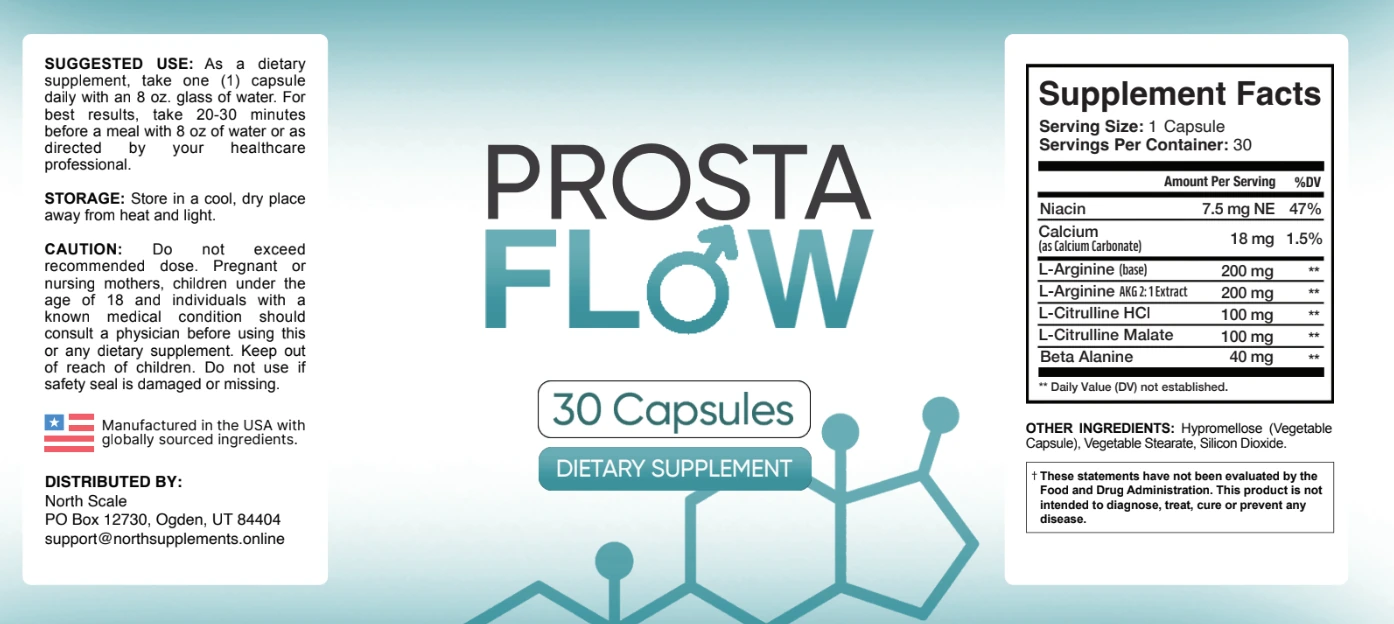
- A salt weight includes the counter-ion. When a label prints 100 mg of an amino acid salt, part of that 100 mg is the partner and never becomes the amino acid.
- A ratio extract works the same way. A 2:1 arginine AKG row is two parts arginine to one part alpha-ketoglutarate, so 200 mg carries roughly 133 mg of arginine.
- This panel prints the ratio on its arginine AKG row, which is more than most labels in any category bother with.
- It does not print a ratio on its citrulline malate row, and malate salts are sold in more than one, so that row cannot be resolved from the label.
- None of this is concealment. It is the ordinary way supplement labels are written, and it is the single easiest thing on a panel to misread.
Why a label prints a salt at all
Amino acids in their free-form base are frequently awkward substances to work with. Some are hygroscopic, meaning they pull moisture out of the air and clump. Some taste appalling. Some are unstable enough that a two-year shelf life is optimistic. Joining the molecule to a partner ion fixes several of those problems at once.
That is the whole reason salts exist on supplement labels, and it is a manufacturing reason rather than a marketing one. A hydrochloride is stable and free-flowing. A malate is easier to handle and, in the case of citrulline, is the form nearly every exercise trial has used. Neither choice is a trick.
The consequence is arithmetic rather than ethics. Whatever the partner is, it has mass, and a scale weighing out 100 mg of the salt is weighing both halves of it.
The same logic outside supplements
This is not peculiar to this shelf. Medicines are dosed and labelled the same way: a tablet strength refers to a specific salt, and switching salts changes the amount of active substance in the same number of milligrams.
What the counter-ion actually is
A counter-ion is the other half of a salt: the part that balances the charge on the molecule you want. In a hydrochloride it is chloride. In a malate it is malic acid, the sharp-tasting acid in apples. In an alpha-ketoglutarate pairing it is a citric acid cycle intermediate rather than a true salt partner, but the weighing problem is identical.
Two questions decide how much a counter-ion matters. The first is how heavy it is relative to the molecule it is attached to. A light partner takes a small share; a heavy one takes a large share. The second is whether the label tells you which partner and in what proportion.
When both are known, the sum is one line of arithmetic. When the proportion is not printed, there is no sum to do, and a confident number would be invented rather than calculated.
Five ways a row can be written
Every supplement row you will ever read falls into one of about five shapes, and recognising which one you are looking at takes a second once you know the list.
| How a row is printed | What the weight includes | What a buyer can work out |
|---|---|---|
| Free-form base, for example L-Arginine 200 mg | The amino acid and nothing else. | Everything. The printed figure is the amount of molecule. |
| A named salt with no ratio, for example L-Citrulline Malate 100 mg | The amino acid plus a partner acid, in a proportion the label does not state. | Nothing precise. Malate salts are sold in more than one ratio. |
| A named salt with a fixed chemistry, for example L-Citrulline HCl 100 mg | The amino acid plus chloride, in a proportion fixed by the two molecules. | A predictable share, somewhat under the printed figure. |
| A bound extract with a printed ratio, for example an AKG 2:1 extract 200 mg | Two parts amino acid to one part partner acid. | Everything, because the ratio is printed. |
| A standardised botanical, for example an extract standardised to 45 per cent | Plant material plus the marker compound it is standardised to. | The marker amount, if the percentage and the weight are both printed. |
Five ways a supplement row can be written. Only the first and the fourth let a reader turn a printed weight into an amount of the thing they are buying.
The pattern in the right-hand column is the useful part. Two of the five shapes are fully resolvable, one is partly resolvable, and two depend entirely on whether the manufacturer chose to print a number it was not obliged to print.
Running the arithmetic on this panel
Apply that to the label this website sells and the picture is mixed in an interesting way, because the same manufacturer made both the generous choice and the ungenerous one on the same panel.
| Row on this panel | Printed | What the weight is | Resolvable? |
|---|---|---|---|
| L-Arginine (base) | 200 mg | Arginine, free form | Yes. 200 mg of arginine. |
| L-Arginine AKG 2:1 Extract | 200 mg | Two parts arginine, one part alpha-ketoglutarate | Yes, because the ratio is printed. About 133 mg of arginine. |
| L-Citrulline HCl | 100 mg | Citrulline plus chloride | Partly. A fixed share of the weight is the counter-ion. |
| L-Citrulline Malate | 100 mg | Citrulline plus malic acid, ratio not stated | No. The ratio is the missing piece and it is not on the label. |
| Beta Alanine | 40 mg | Beta alanine, free form | Yes. 40 mg. |
| Niacin | 7.5 mg NE | Niacin equivalents, a unit rather than a salt | Yes. |
| Calcium (as calcium carbonate) | 18 mg | Elemental calcium, declared as the element rather than the carbonate | Yes. |
Read from the printed Supplement Facts panel. Two rows need arithmetic and one cannot be resolved from the label at all.
Take the two arginine rows together, since they are the heaviest thing on the label. The base row is 200 mg of arginine. The AKG row is 200 mg of a 2:1 extract, so roughly two thirds of it is arginine and the remaining third is the acid, which is about 133 mg. Added up, a capsule carries around 333 mg of arginine rather than the 400 mg a quick glance at two 200 mg rows suggests.
That is a seventeen per cent difference between the casual reading and the real one, and it exists only because the label printed its ratio. A competitor writing “Arginine AKG 200 mg” with no ratio would look identical and be uncalculable. The pharmacokinetic and safety study of this form ran at 12,000 mg a day, so the gap that actually matters on this row is a different and much larger one.
See every ProstaFlow row and its printed amount
Seven rows, an amount against each, a ratio on the one row where a ratio changes the number, and no proprietary blend. One capsule a day, 30 to a bottle, with 60 days from the shipping date to change your mind.
Two bottles $158 · six bottles $294 · 60-day money-back guarantee
Order ProstaFlow On The Official WebsiteOne capsule a day · 30 per bottle · lot PRO-26/PR-5240
The one row that cannot be resolved
Citrulline malate is the exception on this panel and it is worth being precise about why, because the problem is not that the manufacturer hid something. It is that citrulline malate is a name covering more than one product.
The form is sold in at least two proportions, commonly two parts citrulline to one part malate and also one to one, and those two deliver noticeably different amounts of citrulline from the same 100 mg. Without the proportion, a reader cannot say which one is in the capsule.
The exercise literature that made this form popular is largely built on a specific ratio at gram doses. The strength meta-analysis pooled resistance-training trials at those amounts and found no overall effect, and a 2025 crossover trial ran the two forms against each other in the same subjects, which is the only design that can say whether the malate earns its share of the weight. Neither paper is a reason to distrust this row. Both are reasons to want the ratio printed.
Why this desk prints no number for it
It would be easy to pick the commoner ratio and print a confident figure. That figure would be a guess wearing a decimal point, and a guess is worse than a stated gap.
So the position across this website is the same everywhere the row appears: the two citrulline rows add up to 200 mg of salt weight, the citrulline inside them is less than that, and the exact amount cannot be reached from what is printed. The ingredients page says it in those words and prints no number.
When the difference is worth caring about
Not always, and a label-literacy article that implies otherwise is selling anxiety. Three situations where it genuinely matters and one where it does not:
- When you are comparing two products. A free-form 200 mg row and a salt 200 mg row are not the same purchase, and the cheaper one is sometimes cheaper for that reason.
- When you are comparing a label against a trial. Trials usually state which form they used and at what dose. Comparing a salt weight against a free-base trial dose quietly flatters the label.
- When several products stack. Somebody taking a pre-workout powder and a capsule is adding two amounts together, and both need to be read the same way.
- When the amounts are tiny anyway. Here the salt question is a rounding error beside the main one: every amino acid row on this panel sits far below the dose its own trials used, which the dosage section sets out row by row.
That last bullet is the honest proportion to keep. On this label the counter-ion question changes 200 mg into something under 200 mg, while the dose question changes 200 mg into a fraction of 1,500 mg. Cormio's month-long citrulline trial used 1,500 mg a day. The Citrudose pharmacokinetic study mapped what a range of single doses does to plasma amino acids, and those doses were grams rather than fractions of one.
Four questions to ask of any salt row
None of this is specific to one brand. Salts and bound extracts are everywhere on this shelf, and four questions sort a label quickly.
- Is the form named? Hydrochloride, malate, citrate, aspartate, alpha-ketoglutarate. A row that says only the amino acid name is a row that has told you the most useful part.
- Is the ratio printed where a ratio exists? This is the difference between a calculable row and an uncalculable one, and it is one number a manufacturer either chooses to include or does not.
- Is the declared weight the salt or the molecule? Some labels state both, in brackets. That is the gold standard and it is rare.
- How does the resulting amount compare with the trials? Always the last question and always the biggest one. A perfectly disclosed row at a tenth of its trial dose is a perfectly disclosed row at a tenth of its trial dose.
It prints more than it had to on one row and less than it could have on another. The ratio on the arginine AKG row is a genuine piece of transparency, and the missing ratio on the citrulline malate row is a genuine gap. Both are on the supplement facts page, and neither changes the larger point that the amino acid amounts here are a long way under the doses their own research used.
References
- Moinard C, Nicolis I, Neveux N, et al. Dose-ranging effects of citrulline administration on plasma amino acids and hormonal patterns in healthy subjects: the Citrudose pharmacokinetic study. Br J Nutr. 2008;99(4):855-62. PMID 17953788. https://pubmed.ncbi.nlm.nih.gov/17953788/
- Martin-Olmedo JJ, Miras-Moreno S, Cuadra-Montes K, et al. Malate or Not? Acute Effects of L-Citrulline Versus Citrulline Malate on Neuromuscular Performance in Young, Trained Adults: A Randomized, Double-Blind, Placebo-Controlled Crossover Trial. Int J Sport Nutr Exerc Metab. 2025;35(2):89-98. PMID 39662304. https://pubmed.ncbi.nlm.nih.gov/39662304/
- Aguiar AF, Casonatto J. Effects of Citrulline Malate Supplementation on Muscle Strength in Resistance-Trained Adults: A Systematic Review and Meta-Analysis of Randomized Controlled Trials. J Diet Suppl. 2022;19(6):772-790. PMID 34176406. https://pubmed.ncbi.nlm.nih.gov/34176406/
- Campbell B, Roberts M, Kerksick C, et al. Pharmacokinetics, safety, and effects on exercise performance of L-arginine alpha-ketoglutarate in trained adult men. Nutrition. 2006;22(9):872-81. PMID 16928472. https://pubmed.ncbi.nlm.nih.gov/16928472/
- Cormio L, De Siati M, Lorusso F, et al. Oral L-citrulline supplementation improves erection hardness in men with mild erectile dysfunction. Urology. 2011;77(1):119-22. PMID 21195829. https://pubmed.ncbi.nlm.nih.gov/21195829/