ProstaFlow Official Website › Guides
GuidesProstate Supplement Guides: The Category And The Checks
Two long reads. One is about the category: the symptoms, the six ingredients this shelf is built on, what the best evidence says about each, and the free changes that act faster than any of them. The other is a method, seven checks that work on any bottle anywhere, and it finishes by turning itself on the product sold here.
Written to be useful to somebody who ends up buying nothing at all.
The two guides
One about the category, one about reading a label. Neither needs this website.
The prostate supplement guide
What lower urinary tract symptoms are and why more than one thing can cause them, what the best modern evidence says about saw palmetto, beta-sitosterol, pygeum, pumpkin seed, zinc and lycopene, where amino acid formulas like this one fit, and the free changes that have a randomised trial behind them.
Choosing a prostate supplement
Seven checks, in order of how much each one tells you, with the reasoning attached. The last section scores the product this website sells against all seven and publishes the result, including the three checks it does not pass.
Why a retail desk publishes guides that cost it sales
The obvious objection, answered rather than disclaimed.
There is an obvious objection to a shop writing a buying guide, and it deserves an answer rather than a disclaimer.
The answer is that the alternative is worse for everybody including this desk. A guide written to funnel every reader into one product is transparent within two paragraphs, and a reader who notices stops trusting the product pages as well. A guide that is genuinely useful sends some people away, and the ones who stay are buying with their eyes open, which is the only kind of purchase a desk selling a modestly dosed amino acid formula should want.
So the scorecard fails its own product on three of seven checks and says which three. The category guide names the six ingredients the research is about and points out that none of them is on the panel this website sells. Both of those cost orders. They are also the only reason anything else on this site is worth reading.
What this desk earns and how it earns it is set out on the about page, in the same plain terms.
Twelve questions, and which guide answers each
Twelve questions and a direct link to the section that handles each one.
| The question | Where it is answered |
|---|---|
| What are lower urinary tract symptoms, and what usually causes them? | Category guide, the subject |
| Which symptoms mean an appointment this week rather than a purchase? | Category guide, the subject |
| What actually happens at an initial assessment? | Category guide, getting assessed |
| Is a PSA test the same decision as a symptom assessment? | Category guide, getting assessed |
| What does the best modern evidence say about saw palmetto? | Category guide, the six ingredients |
| Why do some prostate formulas contain amino acids instead? | Category guide, the other family |
| What can I change today that acts faster than any capsule? | Category guide, what works first |
| How do I tell a real amount from a proprietary blend? | Scorecard, check one |
| Why does a salt weight or a 2:1 ratio change the number? | Scorecard, check two |
| How do I compare a printed amount with a trial dose? | Scorecard, check four |
| What do the roundels on a pack actually establish? | Scorecard, check five |
| How does the product sold here score against all seven? | Scorecard, the scorecard applied |
Seven questions in the category guide and five in the scorecard. The last row is the one most people came for and it is the one with the failures in it.
The split between the two is deliberate. The category guide is about the subject and would be worth reading if this website sold nothing at all. The scorecard is about method, works on any bottle, and ends by turning itself on the product this desk sells.
Where to start, depending on what you want to know
Five starting points, depending on what brought you here.
- If nobody has looked at your symptoms yet, start with the category guide's section on assessment. Everything else on this website assumes that step is done, and it is the step that changes what is worth doing next.
- If you are comparing this formula with a saw palmetto capsule, read the category guide's evidence section first, then the ingredients page. The two products are not competing on the same ground and the comparison is not close.
- If you want to read any supplement label better, go straight to the scorecard. The seven checks work on every bottle on the shelf and take about two minutes each.
- If you are trying to decide about this specific product, read the scorecard's final section, which applies all seven checks to it and publishes the failures alongside the passes.
- If you want the free things that act faster than a capsule, the category guide's self-management section is the shortest useful summary of them anywhere on this website.
Both guides carry their sources inline rather than only in a list at the foot, so any claim can be followed to the record it came from without scrolling to the bottom and counting. Where a source is a public body rather than a trial, it is named as one.
Neither is written as an argument for buying anything. The category guide would read the same way if this desk sold nothing at all, and the scorecard is a method rather than a verdict: it works on a bottle in a shop this afternoon, on a product nobody has reviewed, six months after this page was last touched. That is the only kind of buying advice worth publishing.
What these guides deliberately leave out
Six things neither guide does, and why each one is absent.
- A recommended brand. Neither guide names a competitor to buy instead, because a recommendation from a shop is worth nothing and a method is worth something. The scorecard's seven checks work on any bottle on any shelf.
- A verdict on whether any ingredient works. The guides state what each trial dosed and what it measured, and link to the record. Turning that into a yes or a no would be this desk substituting its judgement for a reader's, on a subject where the reviews themselves disagree.
- Dosage advice. Nothing here tells anybody what to take or how much. The guides report what published trials used, which is a different kind of statement and the only one a retail desk has any business making.
- Anything about cancer. Prostate cancer is a separate subject with its own screening question, and mixing it into a page about urinary symptoms would be both inaccurate and alarming. The screening statement is linked where it belongs and nowhere else.
- A promise about this website's own product. The scorecard fails it on three of seven checks, and the guides carry no claim for it beyond the two general lines the seller makes.
- An invented expert. There is no named medical reviewer anywhere on this website. The byline is the ProstaFlow Team, an editorial desk with a written method, because a fabricated credential is the commonest dishonesty in this category.
Two of those omissions cost this desk money and the other four cost it nothing but the temptation. Listing them together is more useful than listing them separately, because a reader can then see which kind of omission each one is.
How these guides are sourced
Four rules, and the second one is why one paper is deliberately absent.
Every citation is a record that was opened
Each paper was located through a live literature search, and the record was read for its title, journal, year and, most importantly, the dose it used. A citation without its dose can be made to support almost anything.
A retracted paper was found and left out
One well-ranked meta-analysis on citrulline and blood pressure was pulled as a candidate for this site's reference list and turned out to have been retracted. The retraction notice was read and the paper was dropped. It still ranks well in an ordinary search, so it will be met again by anybody revising this material.
Public bodies are cited as public bodies
Where the best source is a guideline or a consumer page rather than a trial, it is cited as that and named. NCCIH and MedlinePlus are both plain-English and both worth reading directly rather than through anybody's summary.
Nothing is transferred between doses
A trial that ran at 1,500 mg tells you about 1,500 mg. The guides state the trial dose every time, which is what makes it possible for a reader to notice when a label does not come close to it, including on this website's own product.
Who publishes this ProstaFlow website?
- Franco JV, Trivisonno L, Sgarbossa NJ, et al. Serenoa repens for the treatment of lower urinary tract symptoms due to benign prostatic enlargement. Cochrane Database Syst Rev. 2023;6(6):CD001423. PMID 37345871. https://pubmed.ncbi.nlm.nih.gov/37345871/
- Saw Palmetto. National Center for Complementary and Integrative Health, National Institutes of Health. https://www.nccih.nih.gov/health/saw-palmetto
- Goueli R, Badlani GH, Welliver C, et al. Management of Lower Urinary Tract Symptoms Attributed to Benign Prostatic Hyperplasia: AUA Guideline (2026) Part I: Presentation and Evaluation. J Urol. 2026;216(2):143-151. PMID 42095481. https://pubmed.ncbi.nlm.nih.gov/42095481/
- Grossman DC, Curry SJ, Owens DK, et al. Screening for Prostate Cancer: US Preventive Services Task Force Recommendation Statement. JAMA. 2018;319(18):1901-1913. PMID 29801017. https://pubmed.ncbi.nlm.nih.gov/29801017/
- MedlinePlus. Enlarged Prostate (BPH). Bethesda (MD): U.S. National Library of Medicine, National Institutes of Health. https://medlineplus.gov/enlargedprostatebph.html
- Brown CT, Yap T, Cromwell DA, et al. Self management for men with lower urinary tract symptoms: randomised controlled trial. BMJ. 2007;334(7583):25. PMID 17118949. https://pubmed.ncbi.nlm.nih.gov/17118949/
- Mirenayat MS, Moradi S, Mohammadi H, et al. Effect of L-Citrulline Supplementation on Blood Pressure: a Systematic Review and Meta-Analysis of Clinical Trials. Curr Hypertens Rep. 2018;20(11):98. PMID 30284051. https://pubmed.ncbi.nlm.nih.gov/30284051/
- Using Dietary Supplements Wisely. National Center for Complementary and Integrative Health, National Institutes of Health. https://www.nccih.nih.gov/health/using-dietary-supplements-wisely
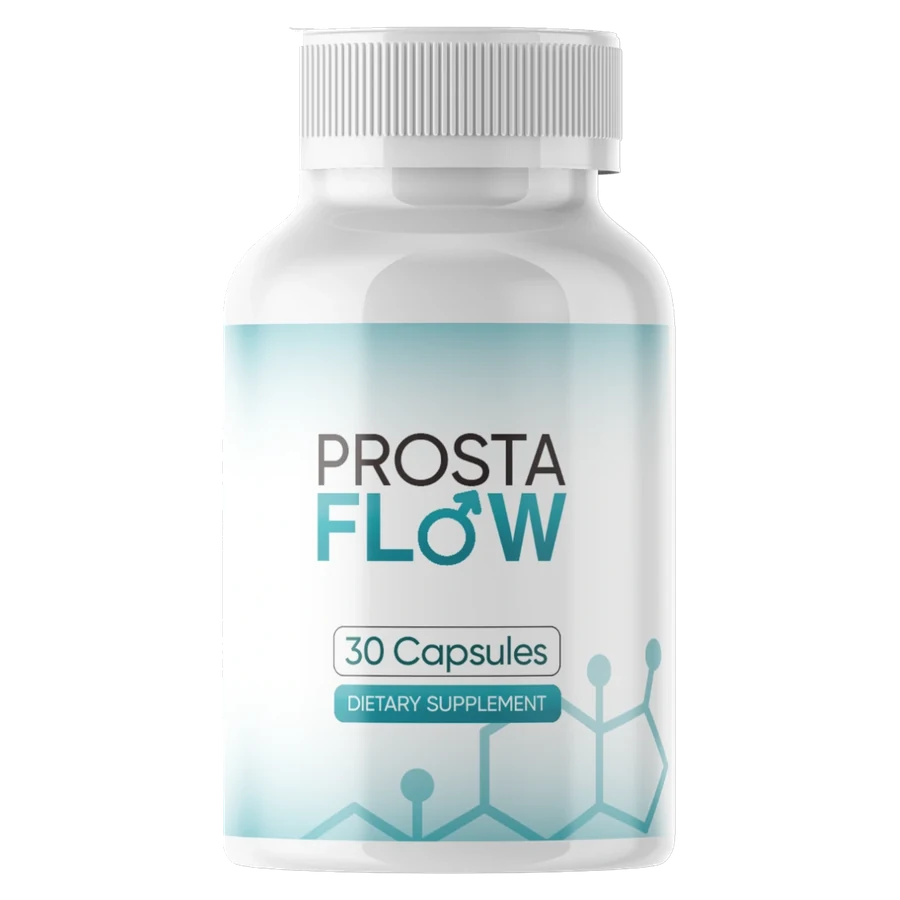
Read the guides, then decide about ProstaFlow
Seven rows with every milligram printed, one capsule a day, and 60 days from the shipping date to change your mind.
Two bottles $158 · six bottles $294 · 60-day money-back guarantee
Order ProstaFlow On The Official WebsiteOne capsule a day · 30 per bottle · lot PRO-26/PR-5240