ProstaFlow Official Website › Ingredients
IngredientsProstaFlow Ingredients List: Every Row Explained
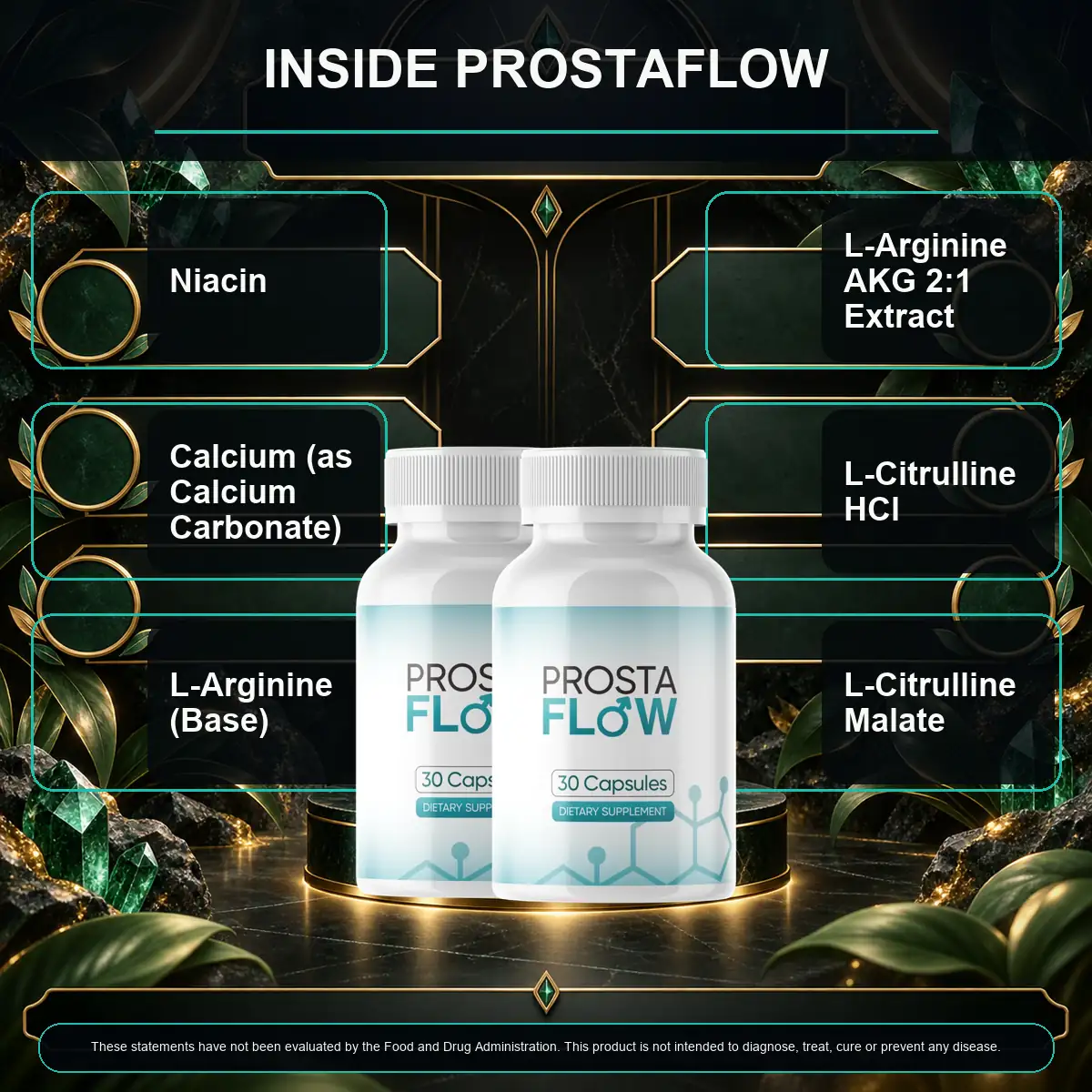
ProstaFlow uses seven ingredients, and every one has a milligram figure on the label.
Five are amino acid ingredients: L-arginine, arginine AKG, two citrulline salts and beta alanine. The other two are the nutrients niacin and calcium. There is no proprietary blend.
The panel in weight order, then the arithmetic that turns a printed row into an amount of molecule.
What is in a ProstaFlow capsule, heaviest row first?
Seven rows and 640 milligrams of declared actives in a single capsule.
| Row as printed | Amount | What kind of ingredient it is |
|---|---|---|
| L-Arginine (base) | 200 mg | A free-form amino acid |
| L-Arginine AKG 2:1 Extract | 200 mg | An amino acid bound to a Krebs cycle acid |
| L-Citrulline HCl | 100 mg | An amino acid as a hydrochloride salt |
| L-Citrulline Malate | 100 mg | The same amino acid as a malate salt |
| Beta Alanine | 40 mg | A free-form amino acid |
| Calcium (as calcium carbonate) | 18 mg | A mineral, 1.5% of a daily value |
| Niacin | 7.5 mg NE | Vitamin B3, 47% of a daily value |
Printed on the label in panel order, which puts the nutrients first. Weight order is the more useful way to read it, so that is the order used here.
Added up, one capsule carries 640 milligrams of declared actives. Four fifths of that weight is arginine or citrulline in one form or another, which tells you what kind of formula this is before a single study is opened.
The two nutrient rows at the foot are the smallest by weight and the least controversial. Everything interesting about this panel is in the five rows above them, and three of those five need a second look before their numbers mean what they appear to mean.
The two arginine rows on the ProstaFlow panel
Two forms of one amino acid, and the reason the second figure needs adjusting.
Arginine appears twice on this label in two different forms. That is a deliberate formulation choice rather than duplication, and the second of the two rows carries less arginine than its figure suggests.
L-Arginine
free-form base200 mgA semi-essential amino acid, which means the body makes some of its own and can use more from food when supply is short. Meat, fish, dairy, nuts and seeds all carry it, and an ordinary mixed diet supplies several grams a day, which is a useful piece of context to hold beside a 200 mg row.
In free-form base it is the molecule itself with no counter-ion attached, so 200 mg on the row is 200 mg of arginine. Of the five amino acid rows on this panel, this is the only one where the printed figure needs no adjustment at all. The dose-response work on oral arginine is the clearest picture of what the molecule does at amounts far above this one.
L-Arginine AKG
2:1 extract, arginine with alpha-ketoglutarate200 mgAlpha-ketoglutarate is an intermediate in the citric acid cycle, the reaction sequence every cell uses to turn fuel into usable energy. Pairing it with arginine was an idea from sports nutrition rather than from urology, and it arrived on shelves in the early 2000s.
The useful detail is the 2:1 printed on the row itself. Two parts arginine to one part alpha-ketoglutarate means roughly two thirds of that 200 mg is arginine and the remaining third is the acid, so this row contributes about 133 mg of arginine rather than 200 mg. The label did not have to print the ratio and a great many competitors do not. Printing it is what makes the sum possible. The pharmacokinetic and safety study of this form ran at a dose two orders of magnitude higher.
200 mg from the base row, plus about 133 mg from the AKG row at its printed 2:1 ratio, is roughly 333 mg of arginine per serving. That figure is worth carrying because it is the number the two rows are really offering between them, and it is the one a reader would otherwise have to work out alone.
The two citrulline rows in ProstaFlow, and what a salt weight is
Two salts, one of which can be resolved from the label and one of which cannot.
Citrulline is the other half of this formula and it also appears twice, as a hydrochloride and as a malate. Both are salts, and a salt weight is the single most misread number on supplement labels, so it is worth fifteen seconds of chemistry.
A salt is the molecule you want joined to a partner ion that makes it stable, cheap to handle or pleasant to swallow. The scale weighs both. When a label prints 100 mg of an amino acid salt, some fraction of that 100 mg is the partner and never becomes the amino acid at all.
L-Citrulline HCl
citrulline hydrochloride100 mgCitrulline is named after the watermelon, Citrullus, which is where it was first isolated. It is not built into proteins; it circulates, and the kidney converts it into arginine, which is why it appears in formulas alongside arginine rather than instead of it. The Citrudose study mapped what a range of single doses does to plasma amino acids.
As a hydrochloride, a fixed and known share of each 100 mg is the chloride rather than the amino acid. The proportion is a property of the two molecules and does not change between products, so this row delivers a predictable amount of citrulline that is somewhat under its printed figure.
L-Citrulline Malate
citrulline with malic acid100 mgMalic acid is the sharp-tasting acid in apples and another citric acid cycle intermediate. Citrulline malate is the form nearly all the exercise research uses, and a 2025 crossover trial put the two forms head to head to see whether the malate half earns its place.
This row cannot be resolved the way the one above it can, and the reason is worth knowing. Citrulline malate is sold in more than one ratio, commonly two parts citrulline to one part malate and also one to one, and those two products deliver noticeably different amounts of citrulline from the same 100 mg. The label prints the ratio for its arginine AKG row and not for this one, so this is the single row on the panel where the arithmetic stops.
Put the two together and the position is this. The two rows add up to 200 mg of salt weight, the citrulline inside them is less than 200 mg, and the exact figure cannot be reached from what is printed. This desk prints no invented number in place of it, because a confident figure would be worth less than an honest gap.
Beta alanine, the smallest amino acid row in ProstaFlow
The most researched ingredient on the panel, and the lightest of the five.
Beta alanine is an unusual amino acid: the amine group sits on the second carbon rather than the first, which is why it is called beta, and it is one of the few amino acids the body does not build into protein at all. Its single job of interest is as the rate-limiting half of carnosine, a dipeptide stored in muscle.
That makes it the best-mapped ingredient on this panel by a distance. A Bayesian dose-response model describes how muscle carnosine rises with daily amount and duration, a comparison of two dosing schedules tested how the daily total is best divided, and the International Society of Sports Nutrition position stand gathers the whole literature into one protocol.
At 40 mg it is the lightest of the five amino acid rows and a twentieth of the weight of the arginine base row. Where that figure sits against the position stand is set out on the dosage section of the home page, which is the section whose job it is.
The two nutrient rows on the ProstaFlow label
Both sensible, both small, and one of them is mostly there for the machine.
Niacin, 7.5 mg NE, 47% of a daily value
Vitamin B3, and the unit is worth decoding. NE stands for niacin equivalents, a unit that exists because the body can also make niacin out of tryptophan from dietary protein, at roughly sixty milligrams of tryptophan to one milligram of niacin. Printing NE rather than plain milligrams is the precise way to do it.
Niacin is a required cofactor in the reactions that release energy from food. At 7.5 mg NE this row is a nutrient amount sitting comfortably under the tolerable upper intake level the dose-response meta-analysis established, which is 35 mg a day in the United States and 10 mg in Europe.
Calcium as calcium carbonate, 18 mg, 1.5% of a daily value
Calcium carbonate is chalk. In a capsule at this weight it is doing the job every powder blend needs done: taking up volume, keeping a free-flowing powder free-flowing, and letting a filling machine hit a consistent weight capsule after capsule.
Eighteen milligrams is about a fiftieth of an adult daily intake, so nobody is meeting a calcium requirement from this bottle and the label does not suggest otherwise. The research that debates supplemental calcium and cardiovascular risk, including a meta-analysis of the randomised trials and a 2023 systematic review, concerns doses in the hundreds of milligrams and does not reach down here.
The other-ingredients line on the ProstaFlow bottle
Three inactive ingredients, and the first one decides whether the bottle suits you.
| Printed as | What it is | Why it is in the capsule |
|---|---|---|
| Hypromellose (vegetable capsule) | Hydroxypropyl methylcellulose, a cellulose derived from plant fibre | The shell itself. Plant-derived rather than gelatin, which is what makes this product suitable for a vegetarian diet. |
| Vegetable stearate | The magnesium or calcium salt of stearic acid, a plant fat | A lubricant. It stops powder sticking to the machine that fills the capsules, and it is used in the low milligram range. |
| Silicon dioxide | Purified silica, the same mineral as sand | An anti-caking agent. It keeps a fine powder from clumping in a humid room. |
Three inactive ingredients is a short list for a capsule of this kind. There is no colouring, no sweetener, no flavouring and no preservative to account for.
The first line is the one that changes a purchase decision. A hypromellose shell is made from plant cellulose, so these capsules suit a vegetarian diet. Gelatin shells remain common across this category and are made from animal collagen, so a buyer who cares about that has to read the other-ingredients line on every bottle rather than trusting the front of the pack.
The other two are process ingredients and they appear on a very large share of capsules sold anywhere. Neither is a nutrient, neither has an amount printed beside it, and neither needs one at the quantities involved.
The ingredients ProstaFlow does not contain
Six ingredients this category is built on, and where each of them is here.
This section exists because of what people arrive at a prostate supplement page expecting to find. Six ingredients dominate the category, and the panel above carries none of them.
| What the category usually carries | Where it is normally taken from | On this panel |
|---|---|---|
| Saw palmetto | The fruit of Serenoa repens, usually a standardised extract | Absent |
| Beta-sitosterol | A plant sterol, often from soy or pine | Absent |
| Pygeum africanum | The bark of the African cherry tree | Absent |
| Pumpkin seed | Cucurbita pepo, as whole seed or as an oil extract | Absent |
| Zinc | A mineral, usually as an oxide, citrate or picolinate | Absent |
| Lycopene | The red carotenoid in tomatoes | Absent |
Read against the printed panel. None of the six appears on it in any form or at any amount.
That is a statement about contents rather than a verdict. Saw palmetto is the most studied of the six and the 2023 Cochrane review is the fairest place to see what the best modern evidence for it looks like; NCCIH's page on the same ingredient covers the same ground in a paragraph rather than a hundred pages. Neither is flattering enough that this panel should be judged only by its absence.
The point is narrower and it is about shopping rather than science. Anyone who came here looking for a saw palmetto capsule should read the panel before ordering, because this is a different kind of formula wearing a name from that shelf. What it is instead, and how it is meant to work, is set out on the how it works page.
How this desk read the ProstaFlow ingredient list
Four rules, and the second one is why this page has a gap in it.
The printed panel is the document that governs
Every figure on this page is read off the Supplement Facts artwork that ships with the product, reproduced in full on the supplement facts page. Where a trade sheet and the bottle disagree, the bottle is what arrives in the box and the bottle wins.
Ratios and salt forms are read, not assumed
The 2:1 on the arginine AKG row is printed and is used. The citrulline malate ratio is not printed and is not guessed at. A number this desk cannot source is left as a gap with the reason attached.
Each ingredient is matched to its own literature
Every study linked on this page was located through PubMed, opened, and read for the dose it used before it was cited. The full list, with the amount each trial ran at, sits at the foot of this page.
The comparison lives in one place
The printed amount against the trial amount is a single table on the home page rather than a caveat repeated under every row. Stating it once and stating it properly is the more useful of the two.
Who publishes this ProstaFlow website?
- Shiraseb F, Asbaghi O, Bagheri R, et al. Effect of l-Arginine Supplementation on Blood Pressure in Adults: A Systematic Review and Dose-Response Meta-analysis of Randomized Clinical Trials. Adv Nutr. 2022;13(4):1226-1242. PMID 34967840. https://pubmed.ncbi.nlm.nih.gov/34967840/
- Campbell B, Roberts M, Kerksick C, et al. Pharmacokinetics, safety, and effects on exercise performance of L-arginine alpha-ketoglutarate in trained adult men. Nutrition. 2006;22(9):872-81. PMID 16928472. https://pubmed.ncbi.nlm.nih.gov/16928472/
- Moinard C, Nicolis I, Neveux N, et al. Dose-ranging effects of citrulline administration on plasma amino acids and hormonal patterns in healthy subjects: the Citrudose pharmacokinetic study. Br J Nutr. 2008;99(4):855-62. PMID 17953788. https://pubmed.ncbi.nlm.nih.gov/17953788/
- Martin-Olmedo JJ, Miras-Moreno S, Cuadra-Montes K, et al. Malate or Not? Acute Effects of L-Citrulline Versus Citrulline Malate on Neuromuscular Performance in Young, Trained Adults: A Randomized, Double-Blind, Placebo-Controlled Crossover Trial. Int J Sport Nutr Exerc Metab. 2025;35(2):89-98. PMID 39662304. https://pubmed.ncbi.nlm.nih.gov/39662304/
- Trexler ET, Smith-Ryan AE, Stout JR, et al. International society of sports nutrition position stand: Beta-Alanine. J Int Soc Sports Nutr. 2015;12:30. PMID 26175657. https://pubmed.ncbi.nlm.nih.gov/26175657/
- Rezende NS, Swinton P, de Oliveira LF, et al. The Muscle Carnosine Response to Beta-Alanine Supplementation: A Systematic Review With Bayesian Individual and Aggregate Data E-Max Model and Meta-Analysis. Front Physiol. 2020;11:913. PMID 32922303. https://pubmed.ncbi.nlm.nih.gov/32922303/
- Church DD, Hoffman JR, Varanoske AN, et al. Comparison of Two beta-Alanine Dosing Protocols on Muscle Carnosine Elevations. J Am Coll Nutr. 2017;36(8):608-616. PMID 28910200. https://pubmed.ncbi.nlm.nih.gov/28910200/
- Minto C, Vecchio MG, Lamprecht M, Gregori D. Definition of a tolerable upper intake level of niacin: a systematic review and meta-analysis of the dose-dependent effects of nicotinamide and nicotinic acid supplementation. Nutr Rev. 2017;75(6):471-490. PMID 28541582. https://pubmed.ncbi.nlm.nih.gov/28541582/
- Huo X, Clarke R, Halsey J, et al. Calcium Supplements and Risk of CVD: A Meta-Analysis of Randomized Trials. Curr Dev Nutr. 2023;7(3):100046. PMID 37181938. https://pubmed.ncbi.nlm.nih.gov/37181938/
- Sim MG, Teo YN, Teo YH, et al. Association Between Calcium Supplementation and the Risk of Cardiovascular Disease and Stroke: A Systematic Review and Meta-Analysis. Heart Lung Circ. 2023;32(10):1230-1239. PMID 37743221. https://pubmed.ncbi.nlm.nih.gov/37743221/
- Franco JV, Trivisonno L, Sgarbossa NJ, et al. Serenoa repens for the treatment of lower urinary tract symptoms due to benign prostatic enlargement. Cochrane Database Syst Rev. 2023;6(6):CD001423. PMID 37345871. https://pubmed.ncbi.nlm.nih.gov/37345871/
- Saw Palmetto. National Center for Complementary and Integrative Health, National Institutes of Health. https://www.nccih.nih.gov/health/saw-palmetto
Order ProstaFlow with the panel in front of you
Seven rows, a milligram figure against every one, one capsule a day and 30 to a bottle. Packs run $49 to $79 a bottle with 60 days from shipping to change your mind.
Two bottles $158 · six bottles $294 · 60-day money-back guarantee
Order ProstaFlow On The Official WebsiteOne capsule a day · 30 per bottle · lot PRO-26/PR-5240